
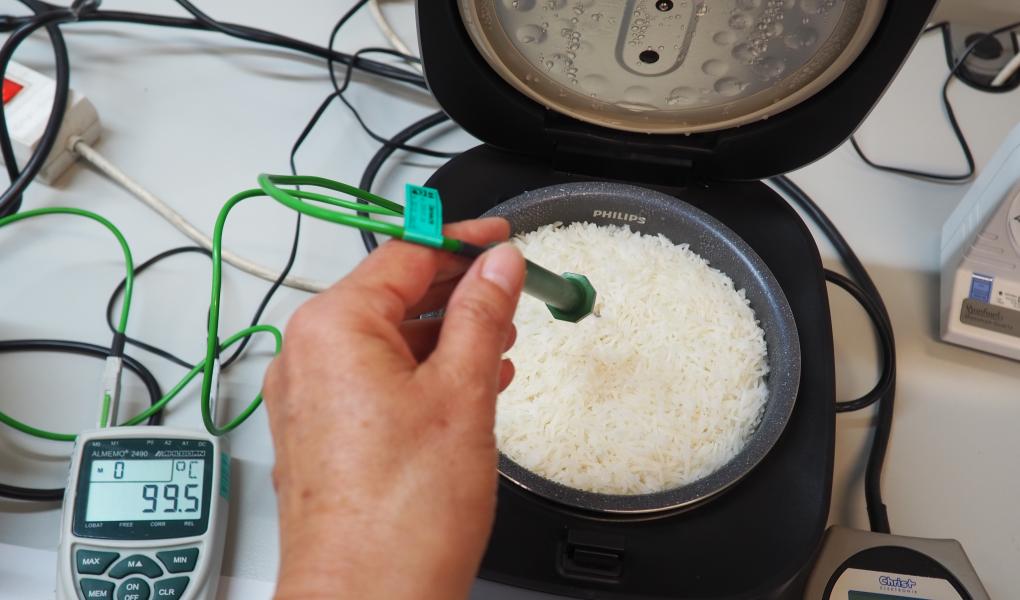
Cooking performance
Each rice cooker is tested using the maximum amount of rice specified by the manufacturer and the appliance’s standard program for white basmati rice. The amount of water is adjusted according to the manufacturer’s instructions.
After cooking, the laboratory carries out a sensory assessment of the rice. The evaluation covers:
- Degree of cooking – whether the rice is properly cooked, undercooked or overcooked.
- Texture – the structure and firmness of the rice.
- Evenness of cooking – whether the rice is cooked consistently throughout the pot or whether different areas have different degrees of doneness.
- Colour of the rice at the bottom – whether the rice remains white or shows discolouration or signs of burning.
The rice cookers are also tested after two hours on the keep-warm setting. The temperature of the rice is measured immediately after cooking and again after the keep-warm period. A second sensory assessment is then carried out using the same criteria.
The sensory result immediately after cooking and the result after two hours of keeping warm each account for 50% of the cooking performance score.
Energy consumption and cooking time
The laboratory measures energy consumption when cooking the maximum amount of rice, as well as the total energy used for cooking and two hours of keeping warm.
To make rice cookers with different capacities comparable, energy consumption is calculated per 100 grams of uncooked rice.
The laboratory also measures cooking time. If the manufacturer recommends a resting period after cooking, this is included in the total cooking time.
Energy efficiency and cooking time each account for 50% of this sub-score.
Ease of use
Three experts assess ease of use in three areas:
Unpacking, initial assembly and start-up – 20%
The experts evaluate how easy it is to unpack the rice cooker, prepare it for use and start the first cooking cycle.
Controls and display – 40%
The assessment covers how clear and intuitive the controls are, how easy it is to select and start a programme, and how clearly the display, indicators and sound signals communicate the appliance’s status.
Handling during cooking – 40%
The experts assess practical handling, including the measuring scale inside the inner pot, the lid design, how easy it is to remove the cooked rice and how safely and easily the inner pot can be lifted out after cooking.
Scoring and weighting
The laboratory results are converted into scores on a scale from 1 to 10, where 10 is best.
The overall score is weighted as follows:
Cooking performance: 60%
Ease of use: 30%
Energy consumption and cooking time: 10%